
The No. 1 pick of the NFL Draft is written in stone — but it could be a rollercoaster ride past that.
Subscribe to read this story ad-free
Get unlimited access to ad-free articles and exclusive content.
The first round of this year’s draft appears more wide open than in recent years, thanks to a slew of dynamics, including a lack of top-tier quarterback prospects, a concentration of premium players across non-premium positions, and relative depth at key positions that will have teams debating whether to take a risk early or to sit back see who falls to them at a later round. Add that to the normal twists and turns of the draft, and Thursday could be must-see TV for any NFL fan.
“There are schemes that are hard to predict, there are grading systems that are all different,” James Laurinaitis, the longtime NFL veteran and current linebackers coach at Ohio State, told NBC News. “That’s why it’s one of the best dramas on television, right?”
Here are five questions that will help to shape how Thursday’s first round shakes out.
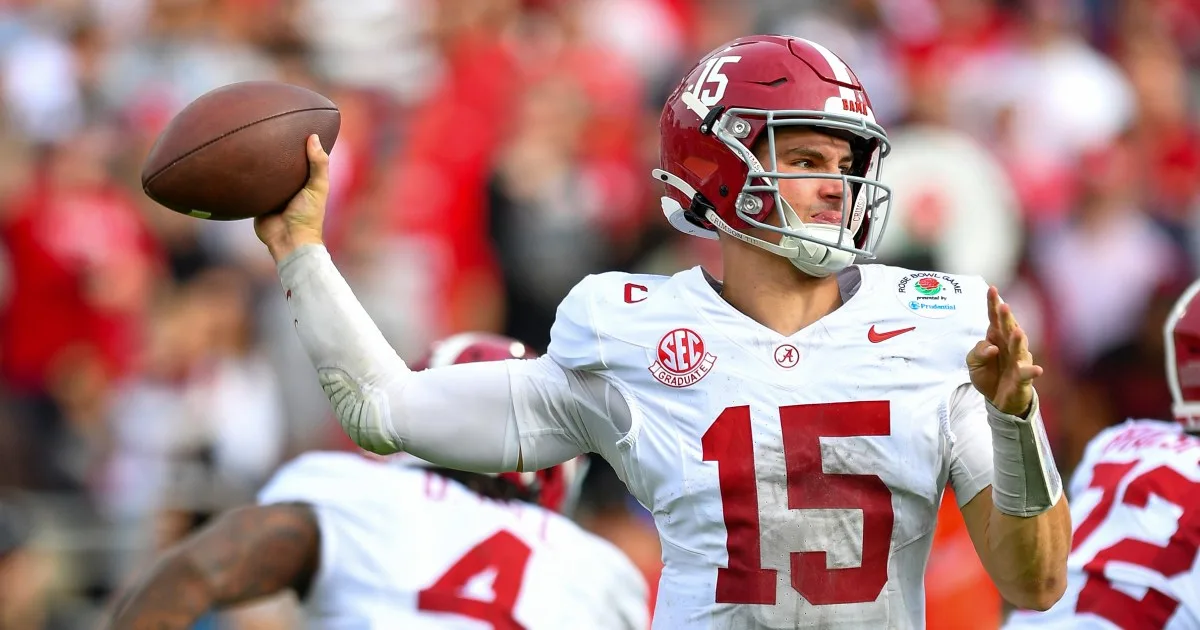
Will Ty Simpson get drafted in the first round?
The worst kept secret this draft is the first overall pick: it’s all but guaranteed the Las Vegas Raiders are going to select Indiana quarterback Francisco Mendoza. But one of the biggest questions is whether another signal-caller will hear his name called on Thursday.
There have only been two drafts in the last 20 years where only one quarterback has gone in the first round — 2022, when the Pittsburgh Steelers picked Kenny Pickett, and 2013, when the Buffalo Bills picked E.J. Manuel. This year, the only real candidate to join Mendoza is Alabama’s Ty Simpson. And the jury is still out.
Simpson is a one-year starter who took the college football world by storm in the first half of the season. But his play tailed off in the back half, exemplified by a poor showing against Eastern Illinois where he threw two picks. It appears Simpson was dealing with a ton of injuries down the stretch, which can help temper some doubts about his abilities. But his stature and lack of starting experience still looms large for teams debating whether to take a risk on him with such a high pick.
Connor Rogers, an NBC Sports NFL Draft Analyst, said Simpson is the “classic case of a day two developmental quarterback” and a “a good athlete” who “he sees and throws the middle of the field pretty well.” He compared Simpson’s ceiling to that of Denver Broncos quarterback Bo Nix, a “solid starting quarterback.”
“But I’m saying the high-end outcome, you’re drafting him hoping he hits in that way, and that, to me, is a top-45 pick, not a top-20 pick,” he said. “And there’s a large difference because when you stake your claim on a quarterback in the top 20 and it doesn’t work, you’re fired. When you do it in the top-45, there’s usually a little room for error.”
Many mock drafts still put Simpson in the back end of the first round, some projecting a trade similar to the one that allowed the Giants to get Jaxson Dart last season. That could make sense for a team that believes in him, especially if the price is similar to what the New York gave up last year and if they want to secure a fifth-year option for Simpson’s services. But Simpson is far from a lock to go in the first round, and since he’ll be at the draft, there’s a risk he’ll be the latest prospect to have to sit there and watch his draft slide in person.
What type of elite edge rusher do teams want?
Edge rusher is one of this draft’s deepest positions, both at the top and into the middle rounds. But the top prospects at the position don’t have much in common.
Ohio State’s Arvell Reese was one of the most exciting players in college football last season, and he’s one of the most intriguing prospects in the draft. Many analysts believe he should transition from linebacker to edge rusher, and are salivating over the fact he had eight sacks and 27 pressures on just 119 pass rush snaps last season, according to Pro Football Focus. But while his future NFL journey is being compared to the one all-pro Micah Parsons took, the ghosts of football’s past are littered with players who failed to convert and couldn’t shake the devastating “tweener” tag.
Texas Tech’s David Bailey doesn’t need much projection — he was one of the most productive pass rushers in college football last season with 15 sacks and another 43 hurries, and dominated the 40-yard-dash and broad jump at the combine. But at 250 pounds, he’s on the lighter side for pass rushers, something that could be an issue for certain teams and certain schemes.
Then there’s Rueben Bain Jr., one of the seven edge prospects since 1999 to have sub-31-inch’ arms, according to MockDraftable.com. Bain was neck-and-neck with Bailey as far as his production as a pass rusher with 12 sacks and 68 hurries last season. But his arm length has been a constant topic of discussion as analysts question whether teams would be willing to spend such high draft capital on such a physical outlier.
When asked how he evaluates these top edge rushers amid these limitations, Rogers said he asks himself “how do those questions affect their game” and whether the player has “complete limitations,” but said that for these three players, that’s not really the case.
For Bain, his “ability to deconstruct blockers with strong hands and then bend around the corner kind of somewhat really limits that concern about his arm length.”
For Bailey, Rogers highlighted his relative lack of bend but added that “he has such good feet and speed that he has tackles so far off balance with his quick steps and all his moves that he really doesn’t need to bend around the corner too often to get after the quarterback.”
And for Reese, his potential position shift, he’s “such a gifted off-ball linebacker with pass rush tools, that if there’s a world that it just doesn’t work for him as an edge pass-rusher, he could still be an all-pro off-ball linebacker.”
How high will the elite players at non-elite positions go?
Usually the top picks in the draft are dominated with the sport’s premiere positions — quarterback, offensive tackle and edge rusher primarily — the ones that command the most money on the open market. But in a vacuum, most draft analysts agree that the best players in this draft class are at positions that aren’t nearly as valuable to teams.
Notre Dame running back Jeremiyah Love, Ohio State safety Caleb Downs and Ohio State linebacker Sonny Styles are consistently at the top of most big boards. And offensive guard Olaivavega Ioane also comes up regularly as one of the draft’s top players, too. But teams don’t typically spend valuable picks on these positions, in part because it’s much cheaper to find worthwhile starters in free agency (or in the case of running backs, their shelf life is so limited that many teams don’t like to build around a marquee running back).
“Jeremiah Love would be a superstar running back prospect in any draft. Caleb Downs would be as high end of a safety prospect as you’re going to see in basically any draft. Styles is pretty dang close. I don’t think he’s perfect, but he’s really, really close in terms of being that,” Rogers said, adding that he also sees Arvell Reese as a blue-chip prospect.
That’s why teams picking at the top half of the draft have an interesting choice: Should they pick the players they have graded the highest, or take risks on more premiere positions like quarterback, or look past some of the question marks surrounding the top edge rushers?
What do teams do with outliers?
The questions about Bain’s arm length raises another important, broader question, about how teams want to handle players who have something in their profile that makes them an outlier.
For players like Bain, LSU cornerback Mansoor Delane and Utah tackle Spencer Fano, it’s what to make of their very small arms. Delane’s 30-inch arms are in the 8th percentile of cornerbacks in MockDraftable’s prospect database and Fano’s 32 ⅛’ arms are in the 3rd percentile, while Bain’s is in the 1st percentile of edge rushers (the database uses NFL Combine measurements, although pro day measurements can differ slightly).
Arm length isn’t viewed as integral to the cornerback position to the trenches, so Delane’s arms haven’t kept him from being seen as one of the top in the draft. But the discussion around Fano has been similar to the one with Bain, and it is one reason why analysts differ about how to rank him on big boards.
Other players are battling with questions about their size, like USC wide receiver Makai Lemon and Clemson cornerback Avieon Terrell. Lemon’s small wingspan and relatively small stature has likely kept him from rising higher in the process, but he’s still considered a consensus first-rounder and players at his size have found success at the NFL level. But size (and a lack of pre-draft athletic testing) could be a bigger issue for Terrell, who has appeared in fewer and fewer first-round mock drafts in recent weeks.
Miami edge rusher Akheem Mesidor’s profile contains a different outlier — his age. A sixth-year senior, Mesidor will be 25 when he takes his first professional snap. And while he took his game to new heights last season as a pass-rush machine, some teams will balk at his age considering the wear and tear football puts on the body.
But it may not keep him out of the first round. John Spytek, the Raiders’ general manager, gave a nuanced answer when asked during the NFL combine whether age detracts from a prospect’s profile.
“Our analytics department gets mad at me anytime we put a guy up there that’’s a little bit older, in his sixth year and whatever,” he said, “But we’re just looking for good football players, and there’s a million things we consider as part of the process. “
What about players that didn’t play last season?
Evaluating prospects is hard enough — but in two key cases, teams are being asked to weigh how to stack players who played little-to-no football last season against those who did.
It’s not the kiss of death — a handful of future first-rounders opted out of the 2020 pandemic season. But it’s harder in the case of injury, especially when that injury prevents a player from going through pre-draft workouts.
Tennessee cornerback Jermod McCoy didn’t play at all last season after tearing his ACL, but after skipping the combine, was able to run during his pro day. According to longtime draft analyst Todd McShay, who is now with The Ringer, McCoy’s 40-yard-dash and jumps were among the best in the class, a showing that will likely help solidify his spot in the first round. But what the teams found during their medical checks, and whether they have concerns the injury could linger, will go a long way to deciding where McCoy ends up.
The story is more complicated for Florida defensive tackle Caleb Banks, who played just three games last season while battling a foot injury and then broke his foot the day before he participated in the combine.
How teams view these medical issues will be important, as, when healthy, they are some of the most talented players in the draft.
Leave a Reply