
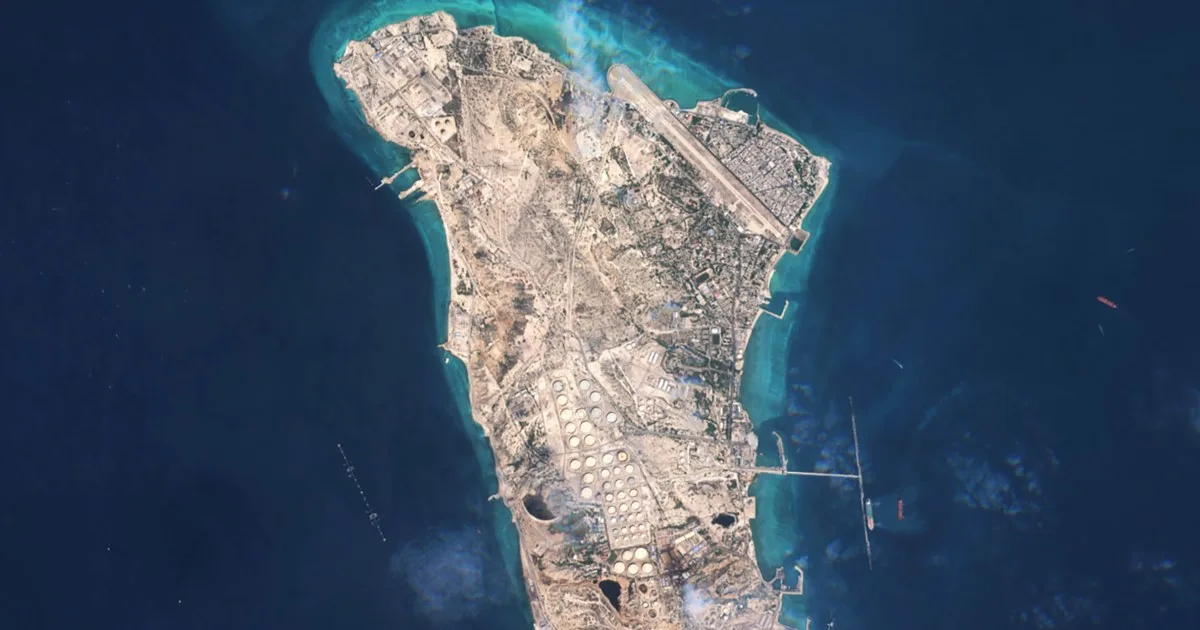
The president is “leaving all options on the table,” Treasury Secretary Scott Bessent told NBC News’ “Meet the Press” on Sunday. “What could happen with Kharg Island? We’ll see.”
The U.S. has already bombed more than 90 targets on Kharg, including air defenses, a naval base and mine storage facilities, Gen. Dan Caine, chairman of the Joint Chiefs of Staff, told a news conference.
It has not been specified why exactly the U.S. forces are headed to the region. They could be used to secure the Strait of Hormuz, blockade — rather than invade — Kharg Island, or merely to continue and assist the operations being carried out by the personnel and assets already there.
But a ground invasion would be far riskier, according to some expert observers.
“Trump would be gambling that the remaining Iranian leadership, faced with the loss of tens of billions in annual revenue, would capitulate,” according to Christian Emery, an associate professor specializing in U.S.-Iran relations at University College London.
But “military success is by no means guaranteed,” he added, with the “real risk of it spiraling into a far more dangerous” situation.
The White House did not immediately respond to requests for comment about the concerns over a ground invasion.
What is Kharg Island?
Because most of Iran’s coastline is too shallow for supertankers, the country pumps almost all of its crude production through underwater pipelines to Kharg.
Once used by Iran’s monarchy to exile political prisoners, this rock is deceptively fertile on the ground.
A short film by regime-controlled broadcaster Press TV last year showed groves of palm trees growing among freshwater springs, a rarity for Gulf islands.
Archeological sites include 2,400-year-old wall carvings and rock-cut tombs, and there is an 18th-century fort built by the Dutch East India Company.
In the 1950s, the island was developed into the sprawling oil facility that exists today. It’s home to at least 8,000 residents, many of them oil workers.
Access is restricted, earning it the nickname “Forbidden Island,” but satellite and aerial images show rows of oil storage tanks, flames gushing from flare stacks, a web of pipelines and vast piers that allow supertankers to transport oil around the world — mostly to China.
“Kharg Island is a lifeline for Iran’s economy,” said Dania Thafer, executive director of the Gulf International Forum, a think tank based in Washington, D.C. Tehran would “likely escalate sharply” if the island is attacked, she said, intensifying strikes on U.S. forces and Gulf energy infrastructure.
Trump himself has downplayed Iran’s potential defenses. “I call it ‘the little oil island’ that sits there, so totally unprotected,” he said last week.
He has had designs on it since at least 1988, when he told The Guardian newspaper that “I’d do a number on Kharg Island; I’d go in and take it” if Iran fired at American troops or ships. Trump noted in the interview that taking the island would be a way to pressure Iran.
At the time Trump made the comments, marine traffic was being disrupted in the Persian Gulf. During the Iran-Iraq war in the 1980s, dozens of merchant vessels were attacked by both parties in what broadly became known as the “tanker war.”
Regardless of Trump’s intent, what’s clear is that extra U.S. personnel are headed to the region. This includes 1,000 paratroopers from the 82nd Airborne Division and 5,000 Marines.
Steaming the Marines toward the Gulf from the Philippine Sea is the USS Tripoli, an amphibious assault ship that could prove useful in any attack on Kharg.
That has not gone unnoticed.
Iran’s parliamentary speaker, Mohammad Bagher Ghalibaf, said Wednesday that his country was “closely monitoring all US movements in the region, especially troop deployments.”
He warned on X, “Do not test our resolve to defend our land.”
Russia, Iran’s ally that has been providing it with intelligence during the war, hopes the idea of a ground invasion “will not go beyond talk and threats,” Foreign Ministry spokeswoman Maria Zakharova told a briefing Wednesday.
Some analysts are bullish.
“It is my opinion that this force is capable of taking the island considering the substantial air and naval power we already have deployed in the region,” said Francis A. Galgano, a former Army lieutenant colonel who is now a professor of military geography at Villanova University.
“If the plan is to win a war against Iran, then taking Kharg Island should be one of the central missions of the conflict,” he added. “It provides the U.S. with enormous leverage in any negotiations and it’s is a ‘stick’ to force the Iranians to stop attacking shipping.”
Others are not so sure.
One senior official from a Persian Gulf country, speaking on condition of anonymity to discuss these sensitive issues, said Iran was “not weak enough yet” for the U.S. to take Kharg.
“I believe the president’s thinking about it” but “I personally, myself, don’t think the timing is right yet,” the official said. “Iran still has tools that it can make an occupation force by the U.S. still very risky.”
Right now, “the regime is definitely not cracking,” the official added. “It’s weaker, but it’s not cracking.”
Others are less optimistic still.
Kharg Island is less than 20 miles from the mainland, well within rocket, artillery and drone range, according to Emery at University College London. It is also hundreds of miles inside the Persian Gulf, meaning any U.S. force would take at least a day to reach it and “providing time for Iran to mine surrounding waters and prepare defenses,” he said.
Even if the U.S. did capture the island, “holding the position would be extremely challenging, with resupply operations exposed to persistent drone, missile and artillery fire,” he said. Ultimately, he believes, it “would be an absolutely disastrous decision that would ensure the conflict lasted many months.”
Leave a Reply