
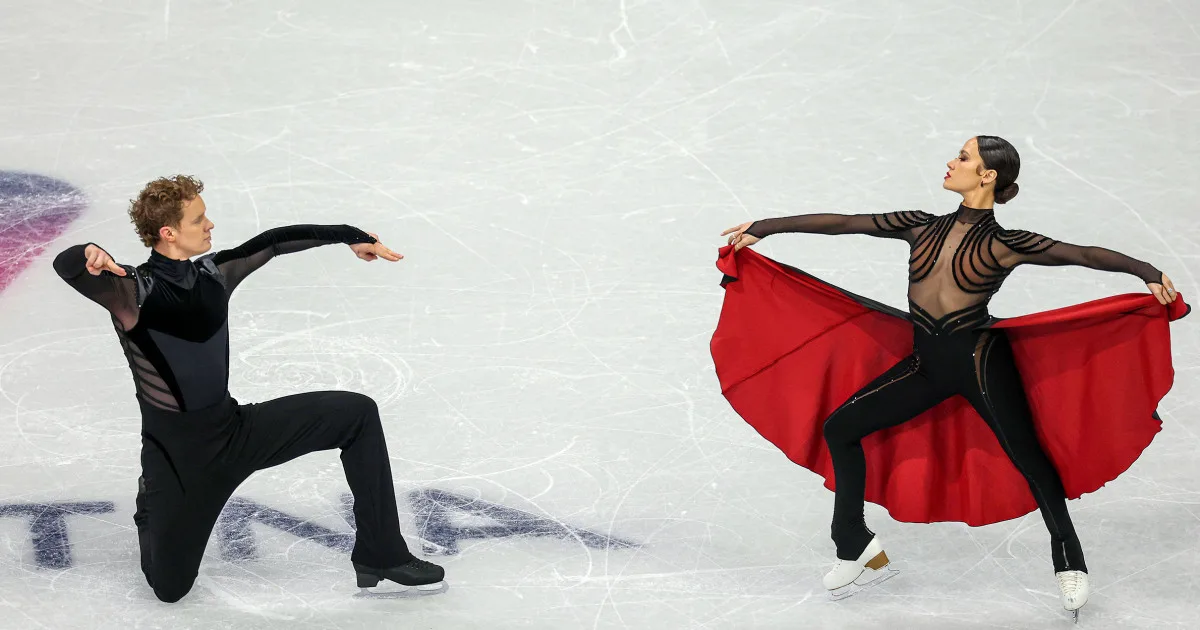
MILAN — The video that Madison Chock posted to social media in 2023 didn’t only show herself and Evan Bates, her husband and ice-dancing partner, in costume. It also included the original designs, sketched by Chock, that served as their inspiration.
“I am now available for costume design consultations,” she wrote.
Chock’s design business quickly gained clients — her competitors.
For the last three years leading up to this month’s Milan Cortina Winter Olympics, Chock has held dual roles as an athlete and entrepreneur, at once trying to beat her competition while also outfitting many of them. In a sport where presentation matters to a pair’s score, 10 skaters donned costumes designed by the U.S. star, she said, including the ice-dancing pairs from Spain, Australia and Georgia.
“I’m helping my direct competition with their costumes, and I think that’s a really beautiful thing about our sport,” Chock told NBC News last fall. “Something that I’m happy to do is to share that creativity and help other skaters create something that they feel good in and are excited to wear when they perform. Because I have had costumes that I didn’t always feel my best in, and I know how much of a hindrance that can be when you’re not feeling your absolute best.”
Many a performance sportswear brand’s origin story starts with an athlete. Usually, though, it’s an ex-athlete. Phil Knight co-founded Nike after he finished his career as a University of Oregon distance runner. Gymnasts Bart Conner and Nadia Comaneci started a gymnastics clothing line and gym-equipment supplier after they’d already become Olympic medalists. TYR, the maker of swimsuits worn by Olympians for decades, was founded by Steve Furniss, a 1972 bronze-medalist swimmer.
Chock, however, has balanced building a business while still in her competitive prime. And she’s not alone.
U.S. Paralympian Mike Schultz only got into snowboarding after a 2008 accident led to the amputation of his left leg 3 inches above his knee, ending his career racing snowmobiles. When he had recovered, Schultz was so unsatisfied with the options for competition-ready prosthetics that he created his own. It proved so popular he started a business, BioDapt, to manufacture his designs like the Moto Knee, which, he estimates, is used by 99% of lower-limb amputee Paralympians.
“Anytime I’m lining up in the start gate,” Schultz said, “I’m lined up against the equipment I built in my shop not too long before.”
They aren’t the first Olympians to influence the very equipment their sport uses. South Korean short track speedskater Kim Ki-hoon, a gold medalist at the 1992 and 1994 Winter Olympics, has been credited with innovating the glove that skaters wear on their left hand to maintain balance when they lightly touch the ice around tight corners. Kim poured epoxy that had been left over from strengthening his skates onto the fingertips of a glove on the hunch that it would reduce friction. He likened it to a thimble that protects a sewer’s finger.
“It looked exactly like frog fingers, so they became known as ‘frog gloves,'” he told Olympics.com.
Instead of turning his innovation into a business, however, Kim became a university professor. Athletes like Schultz and Chock, meanwhile, saw a business opportunity.
Even before his life-changing injury, Schultz liked to problem-solve and build in his shop, even fabricating trailers for construction sites. But creating the prosthetics, he said, was about more than the bottom line.
It gave him a piece of his life back.
A month after his crash, “I actually broke down and started crying in front of my whole family [when] we were watching a supercross championship highlight film,” said Schultz, who had been a 10-time X Games gold medalist in motocross, snowmobile and snowbike. “And what hit the hardest was thinking that I wasn’t going to be able to chase a championship again, because that’s what my whole life was about leading up to that point.”
Schultz said he wasn’t the first Paralympic athlete to influence the equipment athletes use and won’t be the last because it takes someone intimately familiar with a piece of equipment’s limitations to tinker with it. He pointed to Zach Williams, a Paralympic Alpine skier from the U.S. who has modified bucket seats used by skiers.
Schultz’s business is a big deal in adaptive sports but remains a tiny operation, consisting of himself and his wife, with a limited line of prosthetic models. There are two knee models, including one he used to become a Paralympic gold and silver medalist in snowboarding, and three prosthetic feet designed for downhill skiing, recreational activities and high-impact or heavy lifting sports. The knee can cost around $12,000, he said, while another model he wears daily can reach $75,000 to $80,000. BioDapt makes 200 to 300 sales annually, he said, with about 90% of business coming through clinics that serve veterans as much as athletes.
In recent years, Schultz said insurance companies had begun to increase their willingness to cover some secondary prosthetics, but he hopes more exposure on the Paralympics will increase interest and thus funding to cover such costs.
“When we can be on mainstream TV showcasing this and flying down a mountain, I mean, that’s powerful,” he said.
The cost of adaptive equipment is “the biggest boundary that we are faced with” to getting started in adaptive sports, said Noah Elliott, a U.S. snowboard Paralympian.
Elliott was 15 when a cancer diagnosis led to a full titanium replacement of his tibia, from his knee down to his ankle. It was only after he’d relearned to walk that his body began rejecting the metal and developed an infection that led to a full amputation from just above the knee. Still wanting to compete in sports, Elliott called Schultz after his surgery to ask about the price of the Moto Knee, which started a friendship. Elliott said Schultz helped customize a silver-colored Moto Knee as an homage to his former titanium leg.
Elliott’s insurance would not cover the entire cost of his prosthetic, he said, leaving him with more than $6,000 to pay out of pocket. But Schultz has helped in other ways, Elliott said.
“I remember we were sitting in Finland, it was like my third World Cup, and I was just talking to him, like, ‘How do sponsorships work? You sponsor anybody?’” Elliott said. “And he’s like, ‘I’ll sponsor you.’”
Like Schultz, Chock said her biggest challenge is dividing her time between her fledgling business and an athletic career that absorbs almost all of her focus. But her work has drawn acclaim. A “Dune”-inspired costume that Chock designed and was worn by ice dancer Olivia Smart along with partner Tim Dieck was named the best costume by the International Skating Union. Dieck’s costume was designed by Mathieu Caron, a designer with whom Chock often works closely.
“I didn’t realize, I think, at the beginning how much of a responsibility it would be or how much I would feel responsible for these outfits,” Chock said. “I was like, ‘Oh, yeah, sure, I can help you.’ Then I was like, wait, I really want to give this my all and put my best into giving them something super special that they are going to be excited about.”
At these Olympics, Chock and Bates earned a silver medal in the individual ice-dancing final, while wearing a flamenco-inspired costume of her design. They also won gold as part of the team event for a second consecutive Olympics. Chock said she didn’t feel self-conscious about her designs being under the spotlight in Milan, a fashion capital, but Bates, her husband, said he hoped his wife’s design talent would be noticed by brands.
“The costuming can be a catalyst for so much growth,” he said.
“It changes how you feel when you step on ice,” she said. “How you feel about yourself, how you feel you are perceived by others, and when you feel confident, you can take the ice knowing that you look your best, you feel your best, and then it allows you to really unleash your best performance.”
Just as it would have been easier to begin her business after she’d retired from figure skating, it would have been more advantageous competitively for Schultz to keep his design all to himself while he competed.
That thought did, in fact, cross his mind.
“But honestly, after the first time I saw somebody excel with what I created, it was a whole different mindset, and it was very gratifying,” Schultz said. “I was very proud of it and so, from that point forward, it was just like the bigger picture, like, how can I make all of us go faster?
“Sometimes it hurts when I get beat by a couple hundredths of a second or something to be on the podium. But it softens the blow when I know they’re using my equipment.”
Leave a Reply