
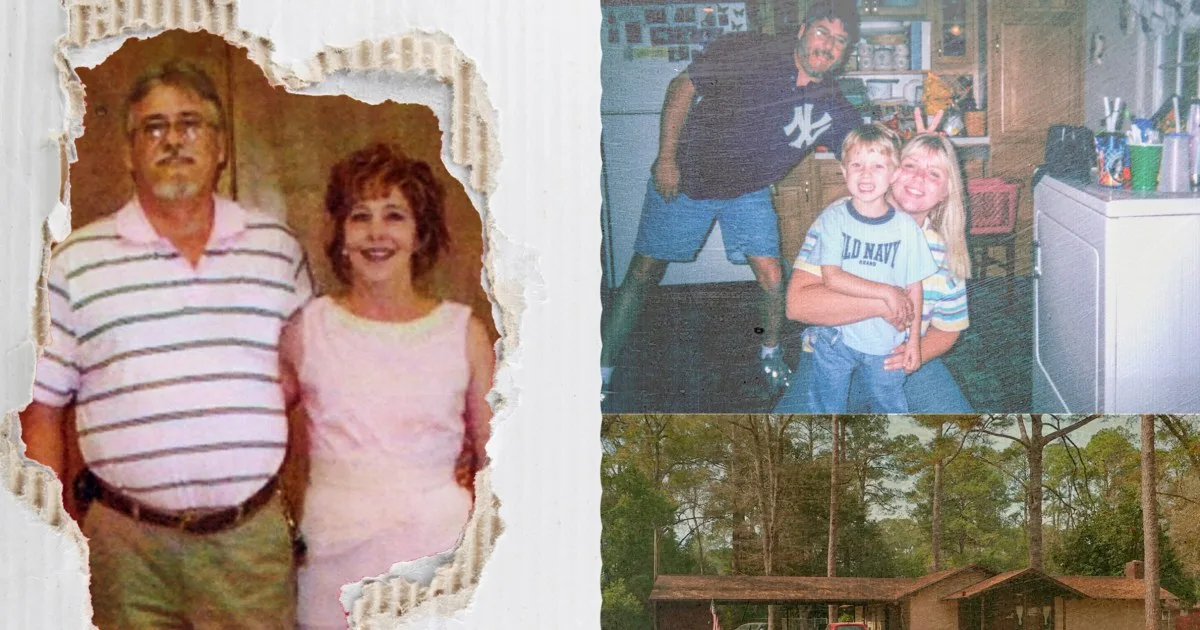
Jake Embert was fatally shot in his Georgia home more than a decade ago.
His family searched for justice for years, enduring a legal saga that spanned three criminal trials and what they said was an agonizing series of failures and mistakes at nearly every level of the justice system in Dougherty County, in the southwest part of the state.
“A slow, grinding, merciless erosion of our humanity” is how his daughter, Rachel Embert, once described it.
For more on the case, tune in to “Malice” on “Dateline” at 9 ET/8 CT tonight.
In January, that process took a big step forward. For the second time, Jake’s second wife, Susan Embert, 61, was convicted of murder in a crime prosecutors described as a financially motivated killing staged as a suicide.
Embert was sentenced to life in prison without the possibility of parole. She has always maintained her innocence and told “Dateline” that she had nothing to do with her husband’s death.
For Rachel, the long-awaited resolution felt like justice. But, she told “Dateline,” “we’re forever broken.”
Newly married and frequently sick
According to Jake’s family, the trouble with the investigation into his June 28, 2014, death began soon after Dougherty County police officers responded to a 911 call from Susan. She reported that her husband had fatally shot himself, a recording of the call shows.
The couple had been married for just over a year. An Army veteran and mechanic at a nearby military base, Jake met her through an online dating site after his marriage of 26 years ended in divorce, his family said.
He was 51 at the time. She was 48.
In the months that followed, Jake’s health began to deteriorate — heart attacks, seizures, stomach pain and nausea. On the day of his death, Susan was broadcast on a countywide police channel telling officers that he’d recently told her he was “sick and tired of being sick and tired,” a recording of the conversation shows.
The officers believed he died by suicide. The same recording captured one of the officers saying it was “obvious” that’s how Jake Embert died. A firearm — a .45 handgun — was “right there in his hand,” the officer said.
The county coroner, Michael Fowler, agreed and ruled suicide as the manner of his death.
Jake’s children and sister doubted that conclusion, however. His son, who was 17 at the time of the shooting, recalled that his father was opposed to suicide, believing that it was a “permanent solution to a temporary problem.”
Nor did the timing make sense to his family. Jake loved cars, and a 1975 Pontiac Firebird he’d owned was set to be raced on a local track on the afternoon of his death, his son, Will, told “Dateline.” The father and son were close — Will described his father as his best friend — and they’d planned on watching the event together with Will’s girlfriend.
Will had gone to pick her up when Jake was shot.
“Knowing that Will was coming right back,” Rachel said, her father “never would have done that to my brother.”
Rachel was also puzzled by what she described as Susan’s lack of interest in holding a funeral. According to Rachel, Susan attributed this to Jake having no close relationships — even though he had “tons of family, tons of friends, tons of co-workers,” Rachel said.
Susan disputed this, telling “Dateline” that she wanted to hold a service but hadn’t had time to get one together.
When the family pushed authorities for answers, they said they got nowhere. Rachel said she repeatedly questioned the coroner while he was at her father’s home the day of his death. And in a phone call that Jake’s sister recorded with a Dougherty County detective and provided to “Dateline,” an investigator told her: “It is what it is. … I can’t change what happened.”
The officers who responded to the scene declined to speak to “Dateline.” In a statement, a spokesperson for the Dougherty County Police Department said the agency is aware of questions surrounding the investigation into Jake’s death but declined to comment “out of respect for the judicial process.”
In an interview with “Dateline,” Fowler said that he was comfortable with his findings based on the information he had at the time — information that included Susan’s comments to police and what he’d been told by law enforcement at the scene.
Questions right away
Jake’s family hired a private investigator, Lee Wilson, who uncovered a range of issues with how authorities handled the investigation. When the former police detective began reviewing records associated with the case, he found that police had taken less than an hour to complete their investigation. No forensic were conducted, he told “Dateline,” and no detectives appeared to have shown up to Jake’s home.
Processing that scene, Wilson said, should have taken hours.
Fowler, he said, could have examined Jake’s body at the morgue and — crucially — checked for gunshot residue on his hands. But no autopsy was completed, Wilson said, and Susan had his body cremated within 24 hours.
When Wilson began reviewing photos of the scene, he said a few things immediately stood out: There was no visible blood on Jake’s hand — as would have been typical for a self-inflicted gunshot wound — and the gun was in an unusual position, tucked under his right leg, Wilson said.
The bedsheets were also unusually positioned. It looked like someone tried to pull Jake’s body back onto the bed, Wilson told “Dateline.”
As Wilson dug into the case, Jake’s family members did their own sleuthing. They’d been suspicious of Jake’s sudden illness — he’d started getting sick only after meeting Susan — and they wondered if she could have been poisoning him. It was a difficult question to answer without his body, but his sister, Yvonne Magnus, recalled asking Rachel to find Jake’s hairbrush and bag it.
Those left-behind hairs, she believed, could contain potential evidence.
The family also came to believe that Susan may have been after Jake’s money. Magnus recalled how after six weeks of marriage, her brother told her that Susan was pressuring him to make her the beneficiary of his life insurance policy. Magnus reminded him that he had an underage son, she recalled, but he assured her that Susan would take care of Will if anything happened to him.
After Jake’s death, Wilson’s investigation found, Susan obtained a payout from that policy and moved to Florida.
Susan told “Dateline” that it was Jake’s idea to make her his beneficiary. She denied poisoning her husband and said that Jake’s family was lying about her.
A murder charge and more
On Dec. 31, 2014, Wilson sent a seven-page document to Dougherty County District Attorney Greg Edwards summarizing his findings. After Edwards’ investigators reviewed the case, the prosecutor came to believe that Susan had likely killed Jake and staged his suicide.
“He was more valuable to her dead than alive,” Edwards told “Dateline.”
Fowler, the coroner, changed Jake’s manner of death from suicide to homicide, and in 2015, Susan was charged with his murder. She was later charged with an additional count of aggravated assault that was linked to the suspected poisoning.
The evidence supporting that charge came from Jake’s hairbrush. Testing ordered by the prosecutor’s office showed that he had antifreeze, insect repellent and other toxic chemicals in his body, Edwards said later in court.
Susan had allegedly been killing him slowly, but Edwards told “Dateline” that a series of events prompted her to take more desperate action. Among them: A friend of Jake’s planned on revealing that Susan had sent him nude photos of herself, Edwards said.
If Jake filed for divorce before his death, the prosecutor said, she wouldn’t be entitled to his insurance benefits.
The family was grateful Susan had been charged, but she denied the allegations and a series of delays stalled her trial until December 2019. Still, after less than an hour of deliberations, the jury found her guilty and she was sentenced to life in prison.
But that conviction was short-lived.
Four years later, it was overturned on appeal after an attorney for Susan discovered that one of her jurors was a convicted felon and ineligible for jury service. Jennifer Hyman had just graduated law school when she took the case and found the detail while doing a Google search, she told “Dateline.”
Susan walked out of the Georgia prison where she was incarcerated.
The development stunned Jake’s family. To his sister, it seemed to be part of a pattern with how the case had been handled since the beginning — one that she said made her question the “whole judicial system.”
Edwards said his office should have taken a closer look at the jurors. But, he added, “we have to rely in some respects on the representations of the jury.”
More setbacks followed for the district attorney. A judge ordered Susan to stand trial again, but as prosecutors prepared for that retrial, the judge barred them from introducing anything linked to a critical part of their case — the poisoning allegation. Defense attorneys had argued that there hadn’t been a proper chain of custody for the hair and the criminal charge linked to that allegation should be dropped.
“Inadmissible, wholly speculative, and unsupported by data,” is how the judge presiding over the case described the toxicology report detailing that evidence, according to NBC affiliate WALB of Albany, Georgia.
Susan’s second trial got underway in December. But those pared-down proceedings were over almost as soon as they began.
On the first day of testimony, Fowler, the coroner, mentioned the word “antifreeze” in response to a question from the prosecutor. Susan’s attorney immediately sought a mistrial — a request Dougherty County Superior Court Judge Victoria Johnson granted on Dec. 8, a filing shows.
In an email to the district attorney’s office the next day, Rachel Embert appeared exasperated.
“For eleven years, we have waited, endured, begged, hoped, shattered, rebuilt, and broken again,” she wrote. “Our father was murdered once. The justice system has destroyed us repeatedly ever since.”
In an interview, Fowler said that no one told him he wasn’t supposed to mention the alleged poisoning in his testimony. Edwards, the district attorney, acknowledged that his office may have let that “slip through the crack.”
“I can’t say that did not happen,” he said.
A damning detail
Trial No. 3 began weeks later with a rearranged team prosecuting the case. Among the details they introduced at trial: Jake was left-handed. But the gun Susan said he shot himself with was found in his right hand.
“If a person is gonna commit suicide with the firearm, that’s arguably the most important shot that person is ever gonna make,” prosecutor William “Dowdy” White told “Dateline.” “Do you make that shot with your nondominant hand?”
Susan’s attorney, Charles Cullen, argued that many left-handed gun owners also shoot with their right hand. But on Jan. 7, a jury convicted Susan of murder.
Three weeks later, she was sentenced to life in prison.
Will said there’s plenty of blame to go around for the tortured path of his father’s case. The coroner, the investigating police officers, the on-call detective, the courts — “it’s them not doing their job,” he told “Dateline.”
Still, Will chose to become a police officer. Often lingering in the back of his mind, he said, is how the authorities handled his father’s death.
“I’m not gonna do my job the way that they did theirs,” he said.
If you or someone you know is in crisis, call or text 988, or go to 988lifeline.org, to reach the Suicide & Crisis Lifeline. You can also call the network, previously known as the National Suicide Prevention Lifeline, at 800-273-8255, or visit SpeakingOfSuicide.com/resources.
Leave a Reply