
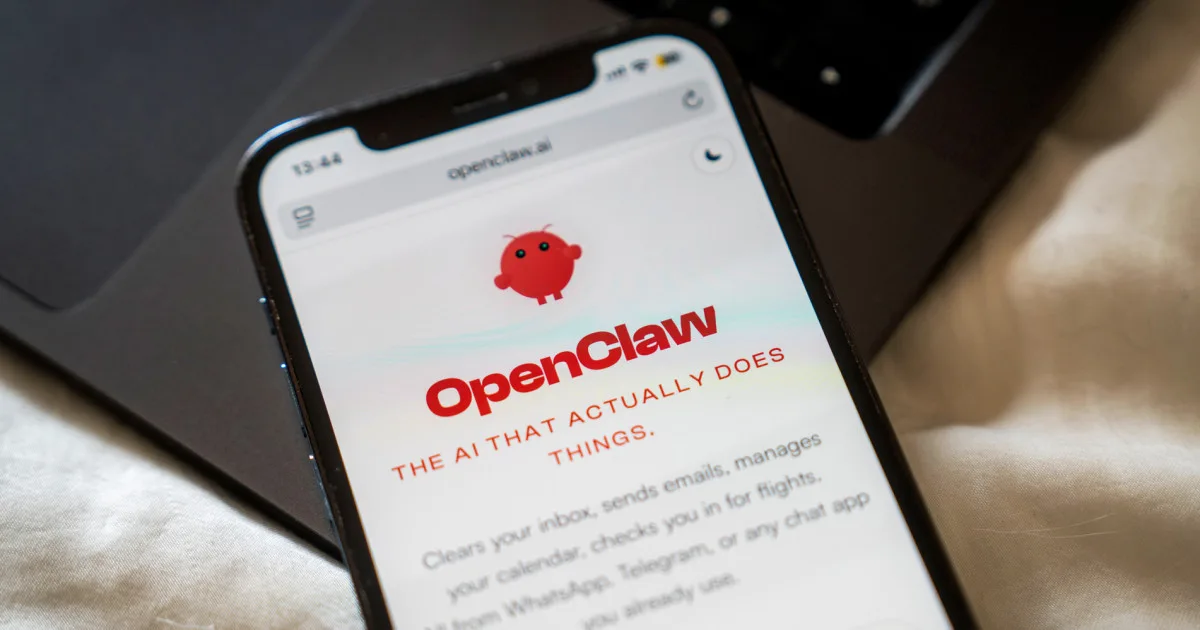
HONG KONG — Finding a job in China’s slowing economy these days often feels like a full-time job itself. But Hu Qiyun has his “lobster” to help.
Since Hu installed OpenClaw, the open-source AI agent has memorized his resume and scours the web each day for any newly posted jobs in software engineering, helping him apply for openings, prepare for interviews and track updates to his application status.
“I treat OpenClaw as my personal assistant,” said Hu, 24, who is based in Shanghai. “It saves me at least three hours each day.”
While most of today’s AI systems require users to write detailed instructions or prompts for every desired action, OpenClaw can be authorized to perform tasks on users’ behalf with little oversight, including sorting and responding to emails, writing reports and making restaurant reservations. Jensen Huang, chief executive of the American tech company Nvidia, has called it “the next ChatGPT,” telling CNBC last week that it is “the most successful open-sourced project in the history of humanity.”
Created by Austrian programmer Peter Steinberger, OpenClaw has taken the world by storm since being released in November — especially in China, where generative AI has been widely adopted with government support as Beijing vies with Washington for global dominance in the strategically vital technology.
Earlier this month, hundreds of people lined up at Chinese tech giant Tencent’s headquarters in the southern city of Shenzhen, waiting for engineers to install the software on their laptops for free. Other events have been held across mainland China, where OpenClaw usage is now almost double that in the U.S., according to the American cybersecurity company SecurityScorecard.
More than 600 million people in China — over a third of the population — use generative AI, according to a Chinese government report last month on the country’s internet development, providing a fertile market for OpenClaw. Chinese internet users refer to the process of installing and training OpenClaw as “raising lobsters,” a play on its red logo.
01:02
China rolls out robo-cops to push robots in daily life
00:0000:00
Beijing-based creator Sky Lei said he has been interested in learning programming and installed OpenClaw on his computer to boost his productivity.
“I kind of saw it as my personal assistant — something that belonged only to me,” he told NBC News in an interview on the Chinese social media platform Xiaohongshu.
“Since I created it myself, it really felt somewhat alive,” he said.
But China’s OpenClaw frenzy, driven by tech companies as well as local governments, has quickly been tempered by security concerns over the software, which requires greater access to individuals’ data.
OpenClaw — which was acquired last month by OpenAI, the American company that created ChatGPT — is capable of taking over a user’s entire computer and can be remotely targeted if safeguards are not properly configured, which is challenging for someone who isn’t a technical user.
That makes it both powerful and risky.
Users in China and elsewhere have shared stories of OpenClaw run amok, deleting emails indiscriminately or making unauthorized credit card purchases. There are also rising warnings about hacking risks.
China’s National Cybersecurity Alert Center said this month that the assets of nearly 23,000 OpenClaw users across the country had been exposed to the internet. The users are “highly likely to become priority targets for cyberattack,” it warned.
The China Academy of Information and Communications Technology, part of the Ministry of Industry and Information Technology (MIIT), says it is developing standards for “claw” agents, “including manageable user permissions, transparency in execution processes, controllable behavioral risks, and trustworthy platform and tool capabilities.”
The MITT’s National Vulnerability Database has also released guidelines for best practices, including granting only the minimum permissions necessary.
As in the U.S., the use of OpenClaw is being restricted or prohibited by Chinese companies and universities, as well as among Chinese government employees and at Chinese state-owned enterprises. Paid installation services that have been popular on social media are now being offered alongside uninstallation services for worried users.
Even tech-savvy users such as Hu are wary about OpenClaw’s vulnerabilities.
“I write some questions, and it has some answers, but I don’t know how it understands my question, how it controls my computer,” he said.
Many have heeded the security warnings, with Lei uninstalling OpenClaw after only three days.
“At this stage, I think the risks and the gains are not proportional at all,” he said.
Despite its risks, authorities and companies in China are doubling down on the technology.
Officials in Shenzhen said earlier this month that they would offer grants of up to 5 million yuan ($700,000) to “one person company” startups building OpenClaw applications. Chinese AI stocks surged last week on Huang’s praise for OpenClaw, and in recent days OpenClaw-based products have been rolled out by Chinese tech giants including Alibaba, Baidu and ByteDance.
On Sunday, Tencent launched a tool that provides direct access to OpenClaw on China’s most popular app, WeChat, which has more than 1 billion monthly active users.
One of the defining features of OpenClaw is that users talk to it like a person, someone who remembers past conversations and is given a name during installation.
“I was reluctant to kill it with my own hands, which shows how risky it felt to me, so I had to uninstall it quickly,” Lei said.
Hu, too, ended up uninstalling OpenClaw after a few days. But then, seeing the software being updated so rapidly, he installed it again.
“Millions of developers make OpenClaw more clever, make it more safe,” he said.
Mithil Aggarwal reported from Hong Kong, and Erin Tan and Janis Mackey Frayer reported from Beijing.
Leave a Reply