
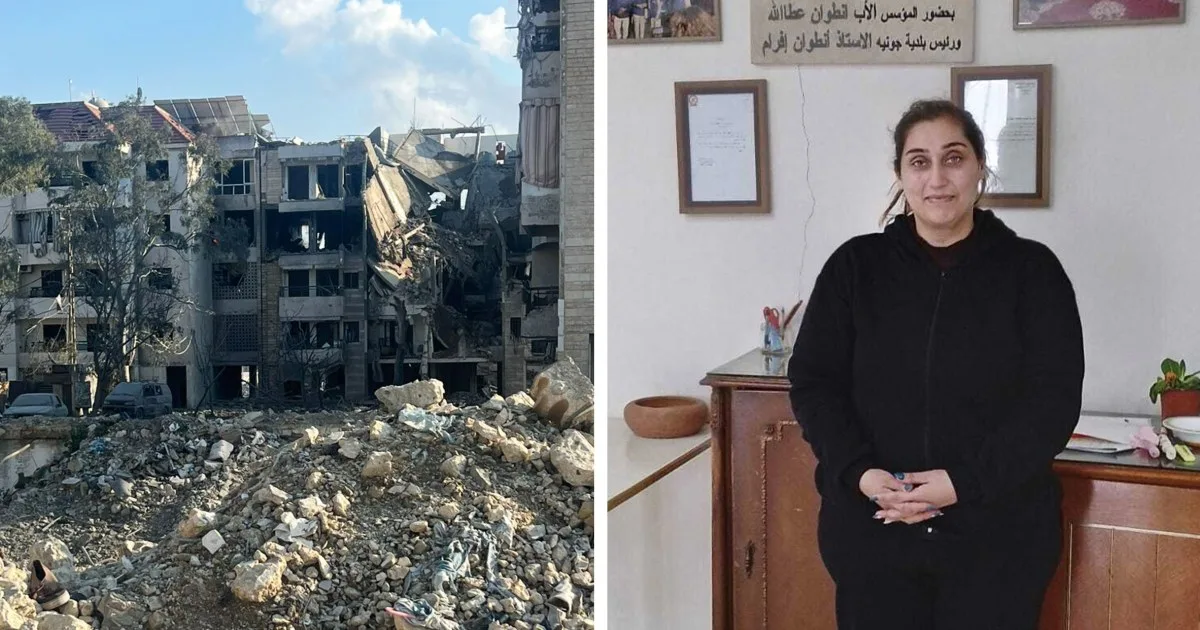
Israel says the buffer zone is necessary to keep the threat of Hezbollah’s rockets away from its border, and its Defense Minister Israel Katz has warned that the hundreds of thousands of families displaced from the south will not be able to return to their homes, or what is left of them, until the safety of the residents of northern Israel can be guaranteed.
More than 1,300 people have been killed across Lebanon and over 4,000 injured since the current war began, according to the Lebanese government.
“It is devastating,” said El Khoury, who is now living in a single room at a temporary shelter in Sehayleh in the Keserwan District, northeast of Beirut, with her three children, ages 8, 6 and 4. She says they have struggled to get access to enough food and basic supplies.
“There is no place to go back.”
Dire circumstances
Humanitarian workers on the ground have described dire circumstances for hundreds of thousands of people displaced across the country, with many sleeping on city streets and in cars in and around the country’s capital, Beirut, as aid groups call for more funding to prepare for the possibility of “long-term displacement.”
“Even if there was some sort of ceasefire, we already know that there are some regions in the south that have been taken over,” Dr. Tania Baban, the Lebanon country director for the Chicago-based nonprofit MedGlobal, told NBC News in a phone interview Friday.
“So, now you have the concern of people who will not be able to — I hope not — but possibly ever go back to their land,” she said.
Abbas Bazoun, 46, said he, his wife and their four children have been living out of their van for weeks now after being displaced from their home in Deir Aames in southern Lebanon.
He said they were barred from bringing their family dog into shelters and, refusing to abandon their pet, had little choice but to sleep in their vehicle.
“My dog is very dear to me, and I cannot give him away,” said Bazoun. He said his family still had yet to learn whether their home remained intact, but that his small shop selling fruits and vegetables had been destroyed in Israel’s offensive.
He said his wife has been left traumatized and suffered a “nervous breakdown” from living through the Israeli fire. “We faced a lot of bombing before we left,” he said.
Sectarian tensions ‘brewing’
Meanwhile, humanitarian groups have also warned of growing sectarian tensions, with displaced people being turned away from communities they have sought refuge in over fears they could potentially be Hezbollah members.
FORSUBSCRIBERS
Richard Engel compares Iran war to Iraq war
02:35
Multiple groups, including the United Nations and MedGlobal, previously told NBC News that they had heard of local municipalities seeking to discourage residents from renting homes to displaced people coming from the south over fears they could be targeted if suspected Hezbollah members were among them.
The New York Times separately reported this week that the Israeli military has told leaders of Christian and Druze communities in southern Lebanon that they can remain in evacuation zones, but has pressed them to force out any Lebanese from neighboring Shia Muslim communities seeking refuge in their communities.
The Israeli military did not immediately respond to a request for comment from NBC News on the allegations.
“I think there’s a lot of anxiety. There’s a lot of concern,” Imran Riza, the United Nations humanitarian coordinator in Lebanon, said in a phone interview on Friday.
“Compared to 2024, there is much more of a sense of insecurity and tension amongst both the host populations and the displaced population,” he said.
Dany Makhlouf, a social activist from Achrafieh, a Christian neighborhood in Beirut, said people there did not want shelters set up in the area after past “issues” during previous rounds of conflict between Hezbollah and Israel.
He said in some instances, displaced people had “put Hezbollah flags in the schools, which created tensions among the residents.”
“Remember, we belong to different political parties, and to us, Hezbollah dragged Lebanon into this war and previous wars,” he said.
Israel occupied southern Lebanon until 2000 and has frequently launched attacks on the area in recent decades, striking out at Hezbollah, which was first founded in the 1980s when Israel occupied southern Lebanon following attacks between the Palestine Liberation Organization and the Israeli military. Hezbollah has long supported the destruction of Israel.
The Lebanese government vowed in 2024 to disarm the militant group as part of a U.N.-brokered effort to bring the previous conflict to an end, but there has been little progress in doing so since.
Bechara Gholam, the mayor of Rmeil, a Beirut neighborhood in the area of Achrafieh, said there were no shelters for displaced people there.
Gholam said that if displaced people do seek to rent apartments in the area, their names are sent to the government for confirmation that they are not known to be involved in “any activity related to Hezbollah.” If they are cleared, Gholam said, “we don’t have any problem.”
“The security of our neighborhood is a priority to us,” the mayor said.
Baban said she was growing increasingly concerned about the “local tension that is brewing” and by reports of Israel trying “to ignite that type of sectarian tension.”
Meanwhile, she worried what would happen to displaced families if Israel does press on with a longer-term occupation of southern Lebanon.
“To be honest, we’re all hoping for a miracle,” she said.
Leave a Reply