
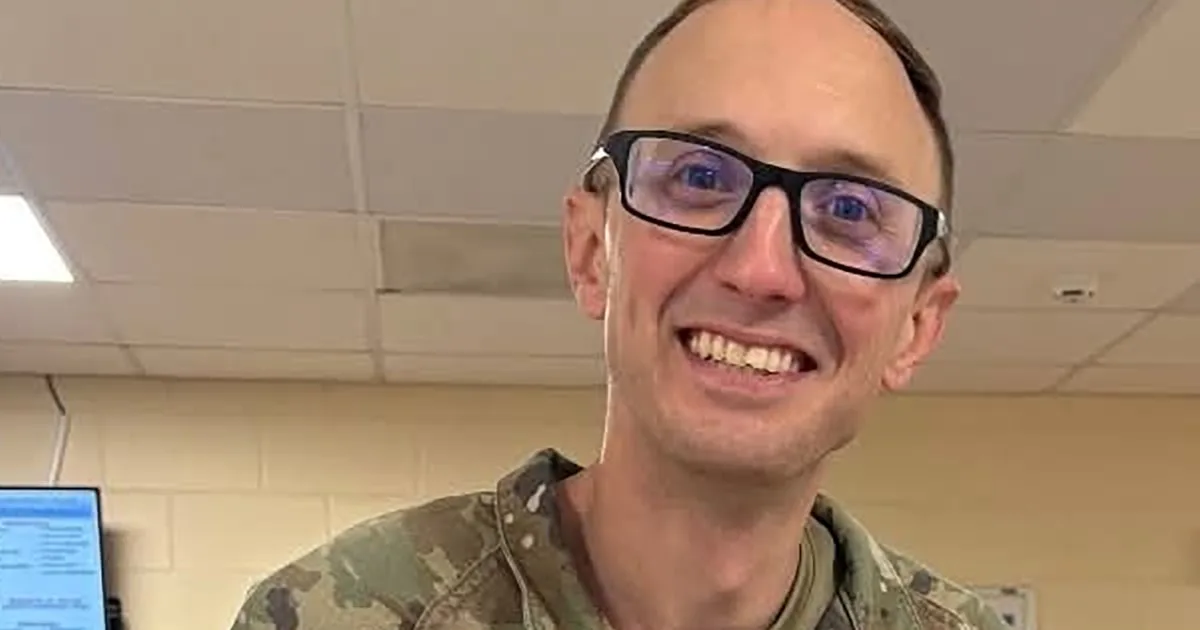
By now, more than a month after her son died in the Iran war, Donna Burhans has found a routine that helps her cope.
Subscribe to read this story ad-free
Get unlimited access to ad-free articles and exclusive content.
If she sits inside and dwells on his death, she gets too upset. She knows this. So, Burhans goes outside and takes solitary walks around her family’s 35-acre farm in Winter Haven, Florida. She gardens and, in the company of the cows, horses, dogs, cats and pigs that live on the grounds, talks aloud about her son, Cody Khork.
“They’re good listeners,” Burhans, 67, said with a laugh.
“They sit there, and I start talking to Cody, or I start talking about him. He was a hero. I’m so proud of him. It just helps,” she told NBC News, in her first interview since her son died.
Khork, 35, was one of 13 Americans killed in the U.S. war with Iran, which has paused while negotiators try to reach a peace deal.
He died on March 1 — the second day of the war — when a drone struck a port in Kuwait. Khork and five other Army reservists died in the attack.
For Khork, the Army was a natural fit. His father was a Marine, and he grew up on military bases. Marveling at the air shows and “crawling” through helicopters parked on the bases, he loved the military life from “Day One,” his mother said.
Growing up, his nickname was “Twig.” He was so skinny he could successfully conceal himself during paintball games by hiding behind a telephone pole, Burhans recalled.
“He’s always been around the uniformed people, so he just loved it from an early age,” she said of the military. “I love that the Army gave him a chance to do what he loves to do.”
Khork died as a captain in the Army Reserve and was posthumously promoted to major. He traveled widely as he carried out deployments in Poland, Saudi Arabia and Guantanamo Bay, Cuba, and, finally, Kuwait.
He had hoped to someday take a job in the Pentagon, Burhans said, and he left behind a fiancée, his first real love.
“I’m thankful for that — that he got to experience true love with a woman,” she said.
As with others who’ve lost service members in the war, neighbors have tried to salve some of the family’s grief. A local barbecue restaurant has stepped up to cater some of the events honoring Khork.
His alma mater, Florida Southern College in Lakeland, has set up an ROTC scholarship in his memory.
Certitudes can be a comfort in times of loss. Burhans relies on her faith and on President Donald Trump’s judgment.
“Trump knows what he’s doing. He knows exactly what he’s doing, and he’s doing everything the way it’s supposed to be done,” she said. “I have my trust in him and God.”
She had a chance to speak to Trump last month at what’s called a dignified transfer ceremony in Dover, Delaware. Khork’s remains and those of the five other service members who died in Kuwait were flown home and removed from the plane in flag-draped containers.
At Dover, Burhans told Trump and Defense Secretary Pete Hegseth that she didn’t want her son to die needlessly and that she hoped they would continue prosecuting the war.
“You could tell when he walked into the room that he was distraught,” she said of Trump. “He had his head down. And he was just a normal, caring person. He wasn’t the president when he walked into the room. He was just there to tell us how sorry he was.”
“I wanted him to know that I do not blame him. I do not blame anything that’s happened for my son’s death,” she continued.
She credited Trump for taking military action against an enemy of the U.S. that has been a global menace for decades.
“It’s a long time coming,” she said. “It should have been done a long time ago, and Trump is the only one man enough to stand up and do it. They hate America.”
“I told him to finish it,” she added. “I said, ‘Go get ‘em.’ This is what my son signed up for.”
In a telephone interview with NBC News on Thursday, Trump spoke briefly about the families of fallen service members.
“I feel so badly for those people,” he said.
Leave a Reply