
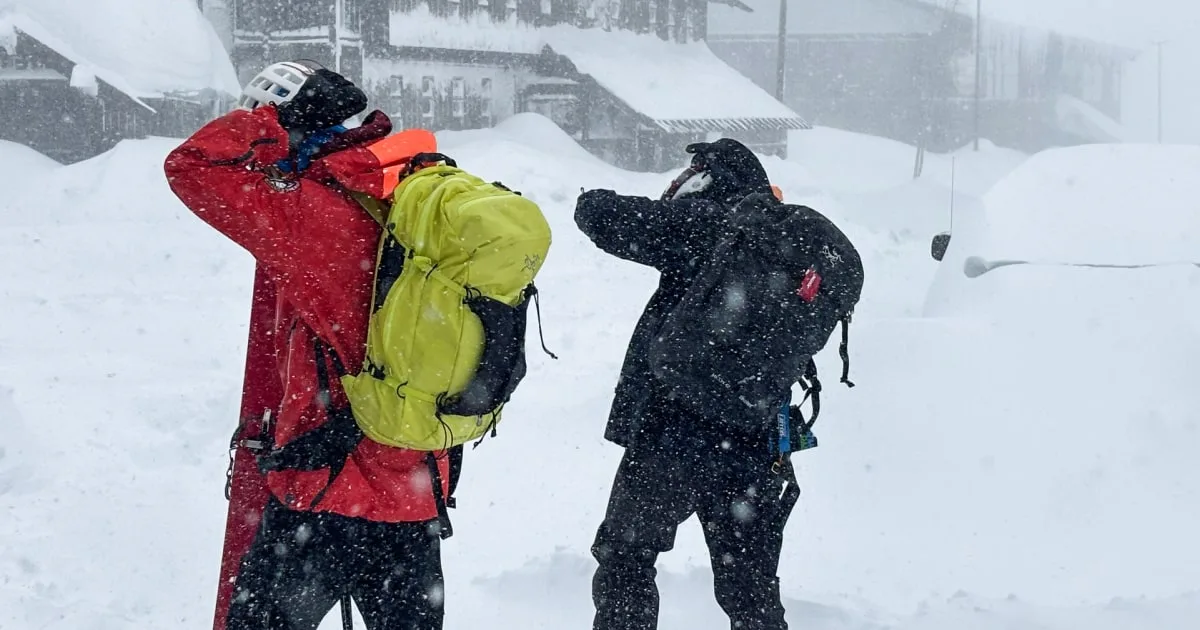
Eight people were killed in an avalanche during a backcountry skiing expedition on the California side of Lake Tahoe on Tuesday, authorities said in an update on Wednesday.
Six others in the party survived. One person is still missing, though presumed dead, as searchers fight near white-out conditions.
“We did have conversation with the families of the folks that are still outstanding and let them know that our mission has went from a rescue to a recovery,” Nevada County Sheriff Shannan Moon told reporters. “It’s a difficult conversation to have with loved ones.”
The avalanche was about a football field in length, authorities said.
The avalanche struck at about 11:30 a.m. Tuesday, sometime after the group of skiers had left a set of backcountry huts at Frog Lake, according to Blackbird Mountain Guides, which had four guides leading the trip. The group had been staying at the lake, which is located northwest of Lake Tahoe and north of the Donner Summit, since Sunday.
“The group was in the process of returning to the trailhead at the conclusion of a three-day trip when the incident occurred,” Blackbird Mountain Guides said in a statement on Tuesday.
The avalanche initially left six skiers injured and nine unaccounted for. The sheriff’s office was able to remain in contact with the surviving skiers through an emergency satellite messaging service that allowed them to send text messages.
Authorities sent a search-and-rescue team on skis into the area on Tuesday afternoon, after receiving notice of the avalanche via Blackbird Mountain Guides and through the satellite messaging system.
The six surviving skiers took shelter in a treed area as they waited for hours for the rescuers to traverse risky avalanche terrain in a whiteout to reach them.
From Monday to Wednesday morning, about 30 inches of snow fell at the Tahoe Donner snow and weather station, which is roughly 4 miles from the site of the avalanche. The weather station is about 800 feet lower in elevation than the avalanche area, which means more snow likely fell where the slide took place.
An avalanche warning was in effect for the Tahoe region on Tuesday, with high risk at all aspects and any elevation.
“Natural avalanches are likely, and human-triggered avalanches large enough to bury or injure people are very likely,” the Sierra Avalanche Center wrote in its bulletin. “Avalanches could be triggered from very low on the slope in some areas.”
Forecasters were particularly concerned that blizzard conditions could cause what’s called a storm slab avalanche. That’s when intense snowfall creates a consolidated layer of snow that does not bond to weaker layers below. The layer essentially shears off and cascades downslope in a matter of seconds.
In an initial report, the avalanche forecasting center said the avalanche occurred on a north-facing slope at an elevation of around 8,200 feet. The location is about a half-mile from the Frog Lake Backcountry Huts.
Avalanches typically happen in terrain with a slope angle between 30 and 45 degrees. The location the center provided is in low-angle terrain, which would have been considered safer for travel, though steep slopes loomed above.
In addition to satellite messaging devices, backcountry skiers typically carry safety gear, including avalanche beacons, shovels and probes, to help locate and rescue companions if necessary. Although avalanches often cause physical trauma — head injuries, broken bones and torn ligaments — the biggest risk is suffocation during a burial longer than 15 to 20 minutes.
The United States had an average of 27 avalanche deaths each year over the past 10 years, according to the Colorado Avalanche Information Center.
In recent history, the most deadly avalanche took place in Washington state in June 1981, when 11 climbers — one guide and 10 clients — were killed during an icefall avalanche on Mount Rainier, according to HistoryLink. The most deadly avalanche in U.S. history overall was in 1910, when 96 people died after a slide struck two trains traveling across Stevens Pass in Washington state.
Leave a Reply