
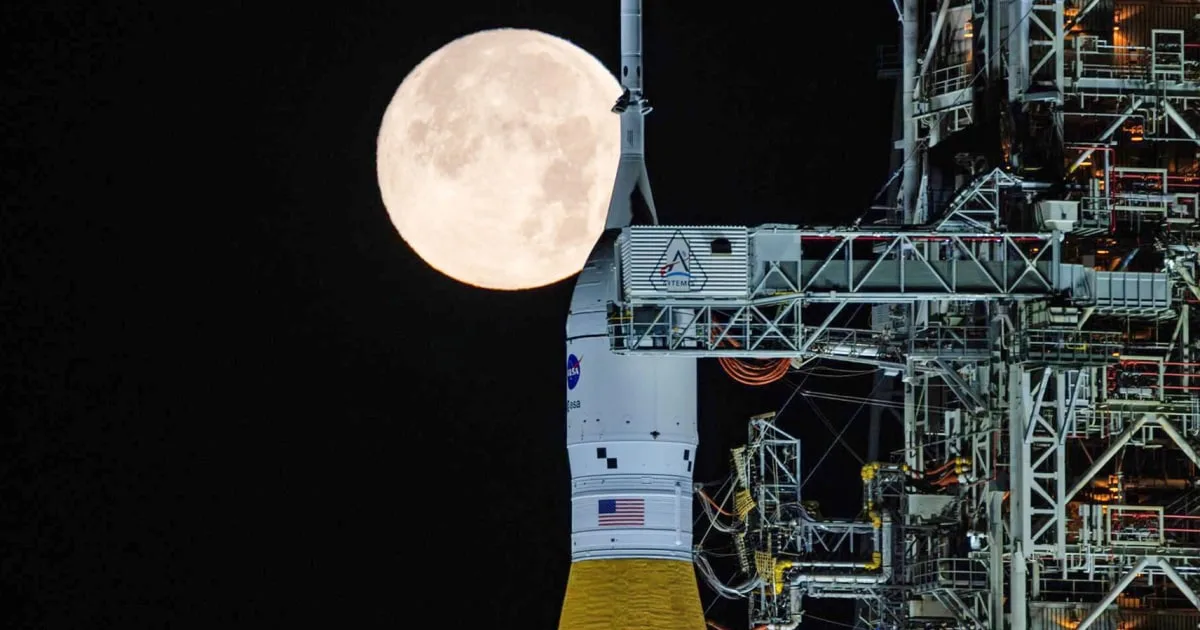
NASA plans to stream the launch live beginning at 12:50 p.m. ET on its YouTube channel, which will also offer live views from the Orion capsule during the mission.
Wiseman said the crew nicknamed their spacecraft “Integrity,” as a nod to the principle that guided them and their colleagues throughout their training.
“Integrity just fit everything,” he told NBC News in an interview in September. “You can be in integrity and you can be out of integrity. And so for us, as the first crew of Artemis, we strive every day to be in integrity.”
The astronauts wanted to convey a sense of unity and togetherness, so Glover said the crew members designed their mission patch to make “A II” — for “Artemis II” — styled to look like the word “All.”
“We want everybody to be a part of this mission,” he said. “There’s a lot of little things that will divide us. It’ll fill in the cracks and expand, if we let it. And it would be nice if this could just be some caulking, some reinforcement to fill in those spaces, to prevent division.”
Around 8½ minutes after they lift off, Wiseman, Koch, Glover and Hansen will be in space. The astronauts will spend the first day of the mission orbiting Earth and testing Orion’s life-support systems, which help regulate temperature, air quality and other factors that keep the crew safe. That includes the spacecraft’s drinking water, food and waste systems.
On the second day of the mission, the spacecraft’s main engines are expected to fire to put it on a path toward the moon.
While en route over the following four days, the astronauts are tasked with testing how well the Orion capsule protects against space radiation and demonstrating procedures for emergencies and other situations in anticipation of future Artemis missions. The next flight in the program, Artemis III, aims to conduct further technology demonstrations in low-Earth orbit — notably, docking in space with a second spacecraft that will carry astronauts to the lunar surface. After that, NASA plans to put astronauts on the moon on the Artemis IV mission in 2028.
Leave a Reply