
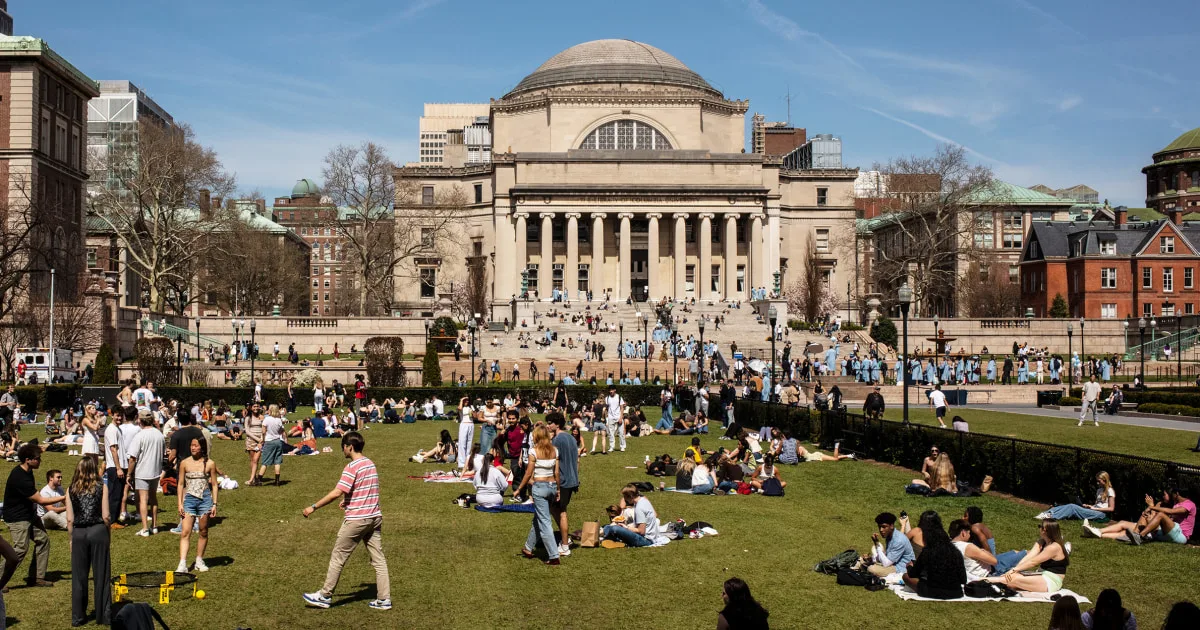
Department of Homeland Security agents allegedly detained a Columbia University student early Thursday morning after making “misrepresentations to gain entry” into a residence hall, the school said.
Columbia University’s Acting President Claire Shipman said in a letter that federal agents entered a residence hall at around 6:30 a.m. and detained the student. The letter added that the university’s administration is working to contact the family and provide legal support.
“Our understanding at this time is that the federal agents made misrepresentations to gain entry to the building to search for a ‘missing person,’” Shipman wrote. “We are working to gather more details.”
It is unclear which Homeland Security agency these agents were with and why the student was detained. The school also did not provide details on the student’s identity.
The Department of Homeland Security did not immediately respond to a request for comment.
In the letter, Shipman reminded the campus community that law enforcement agents must have a judicial warrant or judicial subpoena to access non-public areas of the school. If law enforcement requests access, Shipman told students, faculty, and staff to ask the agents to wait and contact the university’s public safety office.
“Do not allow them to enter or accept service of a warrant or subpoena,” Shipman urged.
The letter from the acting president added, “An administrative warrant is not sufficient” to access non-public areas of the campus.
NBC News previously reported that an internal memo from Immigration and Customs Enforcement in May said agents are allowed to forcibly enter a person’s home using an administrative warrant if a judge has issued a “final order of removal.” That is a departure from previous norms, in which a warrant signed by a judge or magistrate was necessary for agents to forcibly enter homes.
Gov. Kathy Hochul mentioned the alleged incident this morning, saying the details were still unclear. But Hochul said that if the accusations that misrepresentations were made are true, “that just goes to prove our point that this is an organization that is out of control.”
“They need to be refocused, reorganized, retrained, so start over, because it’s just not working,” Hochul said.
Columbia University has become a flashpoint of political tension over the past two years, with active protests against Israel’s war with Gaza, immigration, and criticism from President Donald Trump.
The Trump administration ordered the cancellation of $400 million in federal grants last year after accusing the university of failing to act “in the face of persistent harassment of Jewish students.”
A letter was sent to the Columbia University trustees and former interim president laying out conditions to restore its federal funding, which included a ban on masks on campus and comprehensive reform of its admissions “to confirm with federal law and policy.”
The university acquiesced to the demands last year to restore its grant funding. It also agreed to pay a $200 million settlement to the government to resolve allegations that it violated anti-discrimination laws.
According to the university, the agreement preserved “Columbia’s autonomy and authority over’faculty hiring, admissions, and academic decision-making.”
Homeland Security agents also executed search warrants on two Columbia University residences last year, though no arrests were made at the time. The search came days after Palestinian activist Mahmoud Khalil, a Columbia University graduate student at the time, was arrested by immigration authorities.
Khalil was released in June after three months in immigration detention, following widespread protests and a legal battle to keep the legal permanent resident in the United States. Attorneys for Khalil argued that his detention was a targeted retaliation for Khalil’s pro-Palestinian views and, therefore, unconstitutional.
His status remains uncertain after an appeals court overturned a lower court ruling last month, saying Khalil had to continue to move through the immigration court process before challenging whether the detention violated his rights.
This is a developing story. Please check back for updates.
Leave a Reply